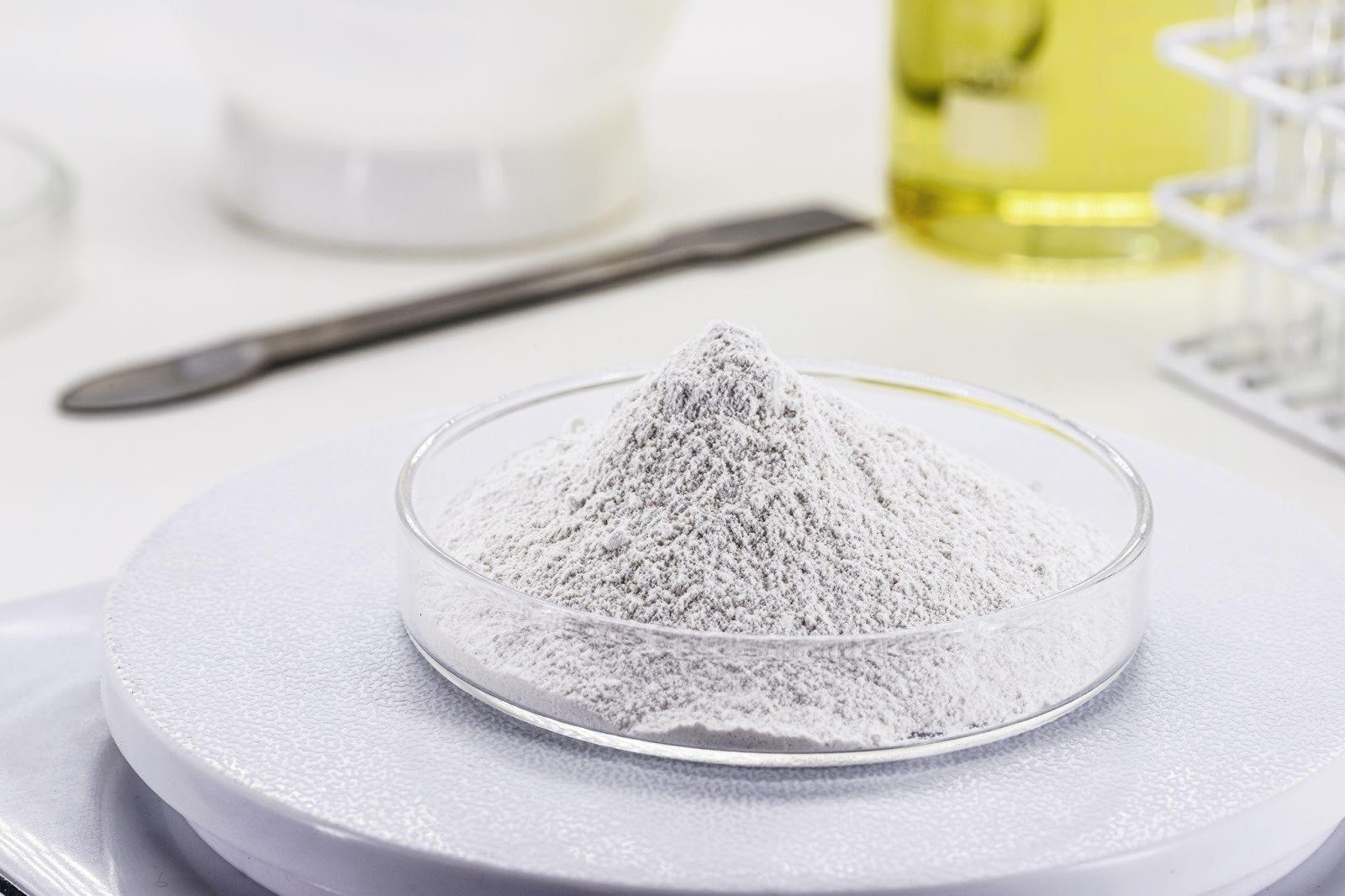
Boron Nitride (BN) is a highly refractory material that has amorphous and crystalline forms. Hexagonal Boron Nitride (hBN) is one of its most stable forms. Hexagonal Boron Nitride (hBN) is also referred to as ‘White Graphite’ as it has a crystal structure similar to that of graphite. Graphite is a deep black-grey material and occurs naturally, whereas hBN is produced synthetically and is white in colour.
Graphite is a well-known lubricant and is used in many applications as a solid lubricant, but it needs the presence of moisture for good lubricity. hBN is a solid lubricant and does not need the presence of moisture for good lubricity. Unlike graphite, which is an electrical conductor, hBN is an electrical insulator and yet maintains excellent thermal conductivity. hBN is a preferred lubricant in applications requiring electrical insulation or heat dissipation.
hBN exhibits lubricating properties due to its lamellar crystalline structure. It has layers of alternate Boron (B) and Nitrogen (N) atoms arranged in a honeycomb lattice. The atoms within the layers are bonded with covalent bonds, where the individual layers are connected with weak Van Der Waals forces.
When a shear force is applied, the layers can easily glide against each other, resulting in a low coefficient of friction. The layers align themselves parallel to the direction of motion, and the atoms with covalent bonds show good load-carrying capacity perpendicular to the direction of motion. This property is used in the lubrication mechanism.
hBN has unique properties like good thermal shock resistance, good chemical stability, good electrical insulator, excellent thermal conductivity, and microwave transparency. It is non-toxic and biodegradable and does not harm the environment. It is not wetted by most molten metal. hBN is used as a solid lubricant in numerous industrial applications.
Reasons why solid lubricants are used
Liquid lubricants and greases are not suitable for lubrication under high vacuum, high temperature, high radiation and cryogenic conditions. In high vacuum, the liquid lubricants can vaporise, and greases can evaporate or outgas and become ineffective. At high temperatures, liquid lubricants can oxidise and evaporate and will not be able to provide lubrication. At high temperatures, conventional greases will break down and lose their lubricating properties. In high radiation conditions, the liquid lubricants can polymerise and form a sludge, while greases can degrade. At cryogenic temperatures, liquid lubricants and greases can solidify and fail. Therefore, for such extreme conditions, solid lubricants like hBN are used.
When placed between two sliding surfaces, the solid lubricants can form a thin lubricating film. Solid lubricants do not vaporise in high vacuum, do not evaporate at high temperatures, do not deteriorate in high radiation and do not solidify at cryogenic temperatures. When hBN is used, its particles interact with the sliding surfaces to form low-friction boundary films. The solid film adheres strongly to the substrate and reduces friction and wear.
Solid lubricants are more effective than liquid lubricants at intermittent loading, high speed and high load conditions. Liquid lubrication systems require a distribution system and seals, which are not required when using solid lubricants. Solid lubricants require simple and lighter equipment for lubrication.
Liquid lubricants tend to pick up dirt and dust from the environment and can increase friction and cause failure. Solid lubricants are preferred as they do not pick up dirt and dust. They are used in food processing, textile and medical applications as they do not contaminate the product. They are easy to dispose of and do not cause harmful emissions.
Solid lubricants are usually used in dry powder form or as bonded solid films. The different ways to apply solid lubricant are as follows:
- It can be applied directly to the solid surface. Fine hexagonal boron nitride powder can be rubbed or polished onto a surface to be lubricated.
- It can be dispersed in oil or used as a suspension to provide lubrication.
- It can be added to grease to enhance its lubricating properties.
- It can be coated or sprayed on the surfaces to be lubricated and then dried.
- Sputtering can be used to coat solid surfaces with the lubricant. In this, the solid lubricant is placed at the cathode and bombarded with an inert gas. The ejected particles are accumulated on the surface of the substrate.
- Ion plating can be used to deposit the lubricant on the substrate. In this, in a vacuum, a plating material/lubricant is ionised and accelerated by an electric field and deposited on the surface,
- It can be used as a composite material to fill the surface irregularities of ceramics and resins.